Health & Wellness
Ukraine’s Underground Technology – The Atlantic

Oct
In a city referred to as Staryi Saltiv, in northeastern Ukraine, many buildings lie in ruins after years of conflict, however just one has been demolished twice: the district faculty. Russian missiles leveled it in early 2022. The city steadily raised the cash not simply to reconstruct it however to enlarge and enhance it, including new amenities for disabled kids. Then, simply days after the work was accomplished in early Might, the Russians despatched 5 Shahed drones into it, leaving it a burned-out wreck.
“We don’t know why,” Iryna Glazunova, the city’s director of training and tradition, instructed me. “I believe the general level is to destroy Ukraine.”
Now an infinite, colourful banner draped over the wreckage reads WE WILL CONTINUE ANYWAY.
They’ll proceed in a reinforced-concrete bunker three tales underground, the place Staryi Saltiv is digging its new faculty out of the earth. Comparable faculties are beneath development throughout japanese Ukraine. Kharkiv, the biggest metropolis within the northeast, has seven main subterranean faculties, and extra are being constructed; the assets being poured into this effort testify to the grim expectation that such amenities can be in use for a few years.
Visiting them is an eerie expertise: Aboveground, schoolyards and jungle gyms are empty and silent. Solely once you descend two or three tales into the bunker do you hear the acquainted shrieks and laughter of kids.
Jedrzej Nowicki for The Atlantic
A faculty lies in ruins within the village of Zalyman, Kharkiv area, Ukraine.
Russian drones have made a transparent sky right into a supply of terror for Ukrainian younger folks. Most have taken instruction solely by Zoom because the full-scale Russian invasion started, in 2022. They examine in residences they share with their mother and father, with frequent interruptions, resembling when the facility goes out or when the air-raid sirens ship them fleeing to shelters. Many are so remoted and anxious that they’re unable to think about a future.
The plight of Ukraine’s younger folks is a direct consequence of Russia’s effort to eradicate their nationwide identification. In rather less than 4 years, Russia has broken or destroyed some 3,500 faculties in an obvious marketing campaign to demoralize the inhabitants and pave the best way for its Russification. The onslaught has additionally decreased church buildings and city halls throughout northeastern Ukraine to rubble, and with them, a lot of the bodily and psychological infrastructure of life for the nation’s youth.
Once I visited the Kharkiv area this summer time, I heard from directors, lecturers, and army officers on the town after city that the isolation of Ukrainian kids presents an existential menace to the nation’s future. To confront it, neighborhood members are constructing new establishments underground and improvising new types of social life.
Younger folks now spend a lot of their life in a subterranean world of colleges, recreation facilities, shelters, even malls. Some adults instructed me that the trouble to create such areas is as essential as something occurring on the conflict’s entrance strains. When Iryna Markevych, a psychologist in Kharkiv, started fundraising for a Cellular College of Resilience in 2022, “folks stated, ‘We solely want cash for the military,’” she instructed me. “We stated, ‘If the youngsters are all sad, what are you preventing for?’”
Three years later, the urgency of the duty is now broadly acknowledged. Ukraine’s adolescents will quickly develop up and be wanted to defend their nation’s fragile civic unity. They might additionally need to struggle in a conflict that would final for a lot of extra years; in the event that they’re fortunate, they are going to then shoulder the even larger burden of rebuilding all that Russia has destroyed.
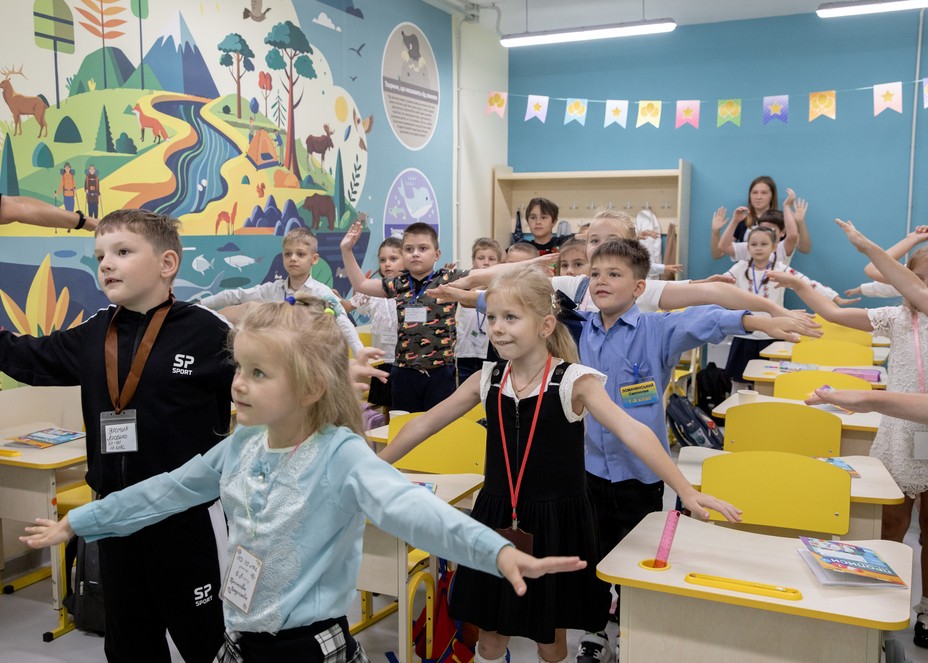
“The gentle temperature is adjusted to re-create the standard of pure gentle,” Yulia Bashkirova, town’s district-education director, instructed me as we descended an immaculate stairwell to go to College 105 in Kharkiv. “The technical necessities have been developed by town corridor.”
Jedrzej Nowicki for The Atlantic
Youngsters attend underground faculty quantity 105 within the metropolis of Kharkiv.
She opened a heavy door to the varsity’s principal hall, and instantly we have been surrounded by flocks of schoolchildren. It was like being inside a submarine. Each sq. inch of area was used for one thing: bookshelves, projectors, wall calendars. The children eat lunch (supplied by the varsity) at their desks as a result of there isn’t any room for a cafeteria. Colourful murals substitute for home windows. Youngsters who would as soon as have been unfold out amongst 9 totally different faculties now attend College 105 in shifts as a result of so many households are determined for an offline-school expertise. Maybe for that purpose, everybody I noticed appeared gleeful.
“There have been academic losses” throughout the years of on-line education, the varsity’s director, Nataliya Teplova, instructed me. “We try to make up for that—further courses throughout weekends, that sort of factor.”
The educational deficits are onerous to measure, as a result of testing protocols have modified up to now three years. In western Ukraine, many faculties went again to in-person courses years in the past. However within the japanese areas near the entrance, motion of any type is harmful, and electrical energy and cellphone service are sometimes disrupted. Educators spoke about 10-year-olds who haven’t but realized to learn. Even underground amenities are often unattainable to construct in these locations, as a result of the development websites get focused.
Jedrzej Nowicki for The Atlantic
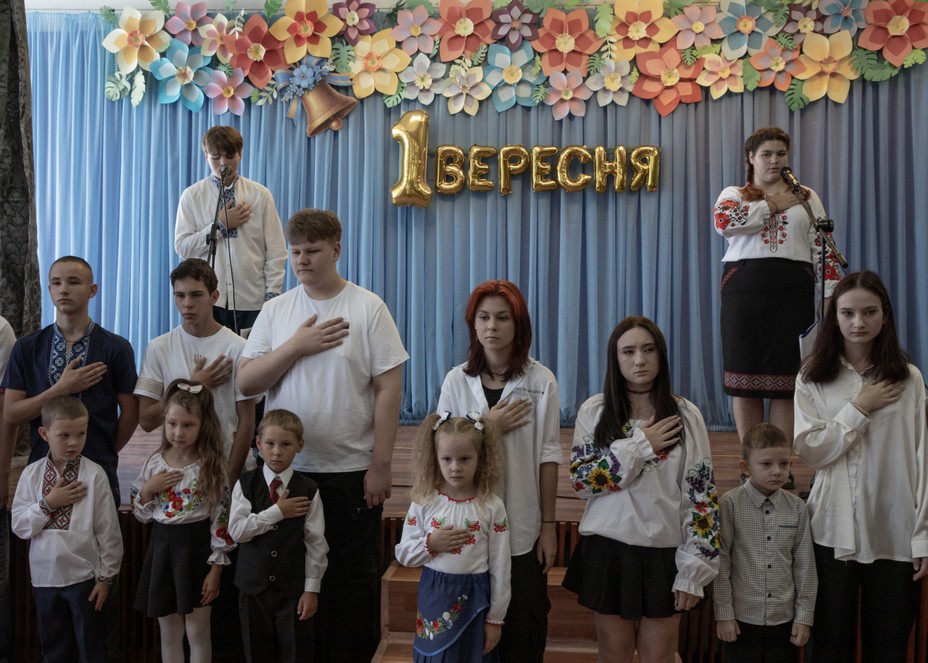
Younger college students have fun the beginning of the varsity yr within the village of Savyntsi.
The conflict’s emotional results are simply as actual however even tougher to measure. “Some kids don’t have any religion sooner or later,” Teplova stated. “They’re extra irritable and have extra bother coping with their feelings. It can take a very long time to cope with that.” When Staryi Saltiv opened its first underground studying middle, “youngsters would are available and simply contact one other youngster,” stated Glazunova, the city’s education-and-culture director, miming a wide-eyed youngster reaching her fingers out hungrily for contact. “They didn’t have the expertise of being near others.”
Each adolescent I spoke with in Ukraine talked in regards to the distress of isolation. “I don’t keep in mind my life with out this conflict,” Solomiia Taranenko, a 19-year-old college scholar in Kyiv, instructed me. As a baby, she stated, “you’d be watching cartoons, then you definately change the channel and also you see a metropolis on hearth” in japanese Ukraine, the place Russia started a proxy conflict in 2014. After the 2022 invasion, she stated, she spent months confined at dwelling; later, she started bringing potassium-iodide tablets all over the place, in case of a nuclear assault. “It turned actually regular: class, air alert, go to the bomb shelter, again to class.”
In a small farming city referred to as Savyntsi, a bunch of native officers described to me a current examine exhibiting elevated most cancers charges amongst younger folks within the space. Illness was simply one in every of some ways, they stated, by which the cumulative stress of conflict had permeated kids’s lives: anxiousness, despair, decreased educational achievement. Nothing, they instructed me, was extra essential than restoring a way of normalcy to the youthful era. In early 2022, the city’s transient Russian occupation ended, forsaking dozens of bombed-out buildings. The officers determined to delay the city’s aboveground reconstruction and as a substitute put all of their efforts right into a regional underground faculty that may accommodate 450 college students from 18 close by hamlets.
“This faculty is our No. 1 precedence,” Oksana Suprun, the mayor, instructed me. Within the meantime, the varsity is sending lecturers to offer classes in smaller underground areas within the hamlets.
Cities like Savyntsi are getting assist from a unfastened motion of nonprofits and zealous volunteers resembling Markevych, the psychologist who based the Cellular College of Resilience three years in the past. Markevych works with about 20 colleagues and spends a lot of her time driving round japanese Ukraine in a van, organizing tutoring and puppet exhibits and handing out books. Within the previously occupied areas, she instructed me, the Russians eliminated the entire Ukrainian books from native libraries.
“Everybody wanted assist in the grey zone” close to the entrance line, Markevych stated about her work, which started as a one-woman volunteer effort in 2017. “Some have been accused of being traitors as a result of they stayed” throughout the Russian occupation. “Some youngsters born after 2014 by no means knew peace.” When she and her colleagues first started organizing summer time camps in previously occupied areas, Markevych instructed me, “some mother and father resisted as a result of the Russians ‘invited’ youngsters on journeys they usually by no means returned.” (Russia has kidnapped virtually 19,000 kids, in accordance with Ukrainian authorities, and a few estimates run a lot increased.)
Markevych briefly teared up as she described the primary summer time after the Russian invasion, when she helped arrange a summer time camp for youths from previously occupied cities. Many have been traumatized, and once they noticed fireworks, “they hid inside and cried,” she stated. “However the camp was essential as a result of they regained contact with associates. That allowed them to start planning their future.”
Jedrzej Nowicki for The Atlantic
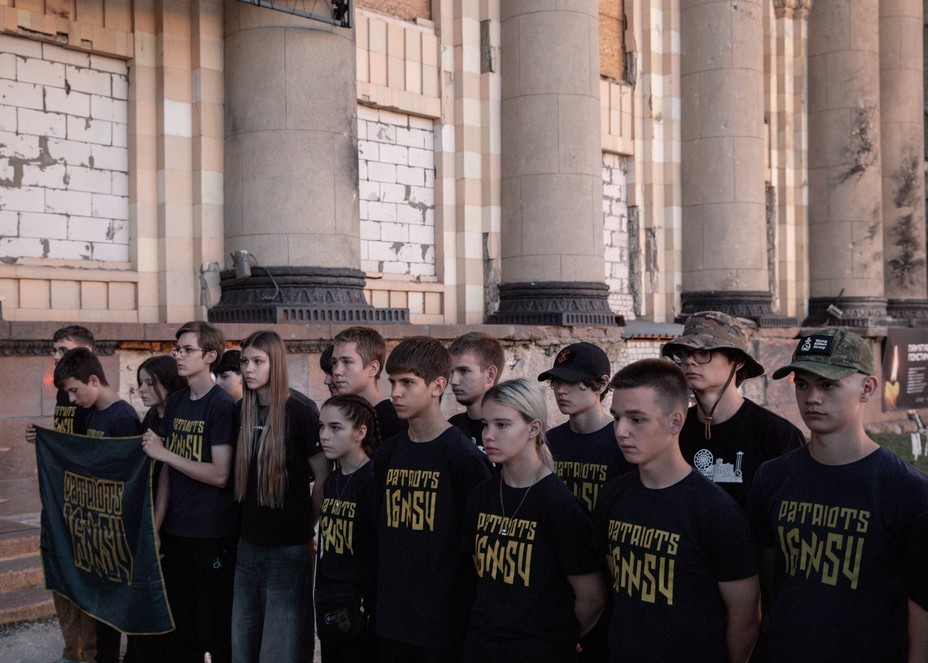
The Patriots 1654 youth group commemorates the Day of Remembrance of the Defenders of Ukraine on August 29.
Ukrainian educators and youngster advocates instructed me that getting kids into actual school rooms was just one a part of their challenge. One other was to bolster their sense of Ukrainian identification. I attended an opening-day faculty ceremony in Savyntsi in early September throughout which each and every speaker—the city mayor, lecturers, valedictorians—emphasised the significance of instructing Ukrainian language, historical past, and tradition. After the speeches got here Ukrainian songs, poems, tributes to troopers, and, after all, the nationwide anthem.
One of many teams that has performed essentially the most cultural-preservation work is Plast, the primary Ukrainian Scouting group, which has expanded its efforts to serve Ukrainian kids because the 2022 invasion. Plast was based in 1911 and banned by each the Nazis and the Soviet authorities. It has taken on a brand new significance up to now three years as a defender of Ukrainian traditions towards the specter of Russification.
Plast has tried to downplay its aggressively nationalist previous. However Yaroslav Yurchyshyn, a member of the Ukrainian Parliament and a former scout, instructed me, “We alternate instructors and information with the Khartia brigade,” a big army unit primarily based in Kharkiv. In a rustic the place 85 p.c of individuals determine as Christian, Plast has an unmistakable, although ecumenical, spiritual orientation: Each Christmas, Plast scouts make their option to the entrance line with a “peace flame” that has traveled all the best way from Bethlehem through an Austrian cathedral. The scouts inform the troopers, “We give this to you,” as they go on the flame, Yurchyshyn stated. “You’ll be able to depend on us. You will have a spot to return to. You’ll return to a greater society.”
Some youth teams work much more carefully with the army. One night in Kharkiv, I occurred upon a memorial service for fallen troopers. Dozens of adolescents stood at consideration in neat rows. All of them wore navy-blue shirts bearing the phrases Patriots 1654, the date of Kharkiv’s founding and the title of a youth wing created by Kraken, a volunteer army brigade primarily based within the metropolis that has a popularity for recruiting bouncers and soccer ultras. One of many youngsters, an athletic-looking teenager named Ladislav, instructed me that 1654 is organized into platoons that practice with Kraken commanders. Lots of them go on to struggle within the infantry. Quite a few different Ukrainian brigades have created their very own youth wings.
These efforts could also be important to Ukraine’s means to keep up the pipeline of latest troopers that it wants for the conflict effort. Everyone seems to be keenly conscious that Ukraine is at a demographic drawback vis-à-vis Russia, which continues to hurl infantry troopers into the conflict with little regard for his or her lives. Many Ukrainians additionally know that simply throughout the entrance line, Russia is engaged in a way more excessive type of youth indoctrination.
In the occupied areas of Ukraine, Russian authorities have been remaking the faculties since 2014, eliminating courses in Ukrainian language and tradition and implementing army coaching alongside a inflexible Russian-nationalist curriculum. These courses begin within the first grade.
Tetiana Lychko, a documentarian at Almenda, a Kyiv-based assume tank that has reported on Russia’s actions within the occupied areas, instructed me that the courses are obligatory, and that if college students don’t attend, their mother and father are referred to as in. Troopers and clergymen go to the faculties to speak to the youngest kids in regards to the significance of the “particular army operation.” In a category referred to as “Safety and Protection of the Motherland,” launched final yr, seventh- and eighth-grade college students be taught to function assault rifles and first-person-view drones. Some specialised “cadet faculties” begin the coaching in preschool, the place 4-year-olds are taught the names of weapons and methods to make camouflage nets for the entrance line. Outdoors faculty, authorities arrange much more superior military-training regimes, resembling Zarnitsa 2.0, an open-air conflict sport with origins within the Soviet period.
Jedrzej Nowicki for The Atlantic
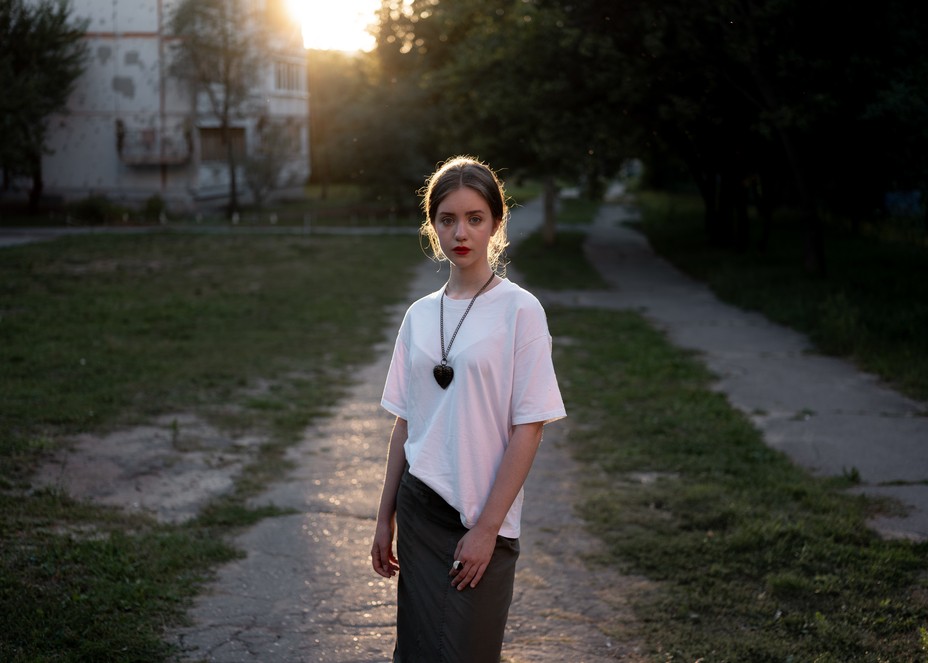
Anna Kovalenko, 19, refused to go away the Saltivka district of Kharkiv regardless of the Russian onslaught there.
Despite Russia’s efforts, Ukrainian kids frequently escape from the occupied areas, many with the assistance of their mother and father. I met one in every of them in Kyiv, an 18-year-old girl from a city within the Donetsk area whom I’ll name Mariya; she requested that I not use her actual title, as a result of she nonetheless has household within the occupied zone. She instructed me that earlier than she escaped final yr, “I didn’t actually perceive I lived in Ukraine—they stated at school it was the republic of Donetsk.” Her mother and father have been against the Russian occupation however too frightened to speak about it. After Russian-backed forces seized Donetsk in 2014, Mariya instructed me, folks loyal to Moscow “pointed to those that have been pro-Ukrainian they usually have been taken away. So most stayed quiet. My household too.”
Mariya was 7 when the occupation started, and the modifications began instantly. “I had the impression that the whole lot went again to the ’90s; there was no funding, and issues decayed,” she stated. “Our college was like what Grandma described.”
Bank cards disappeared, as did cell web entry, and public transport turned scarce and unpredictable. Yr by yr, the propaganda at her faculty grew extra aggressive and all-encompassing, and after Ukrainian courses have been abolished, Mariya’s means to talk the language light. Ultimately, she persuaded her mother and father to let her go away, and her mom accompanied her on a dangerous journey via Russia into the Kyiv-controlled a part of Ukraine. Even now, her mother and father (who stayed to handle a grandparent) inform anybody who asks that she is learning in Russia.
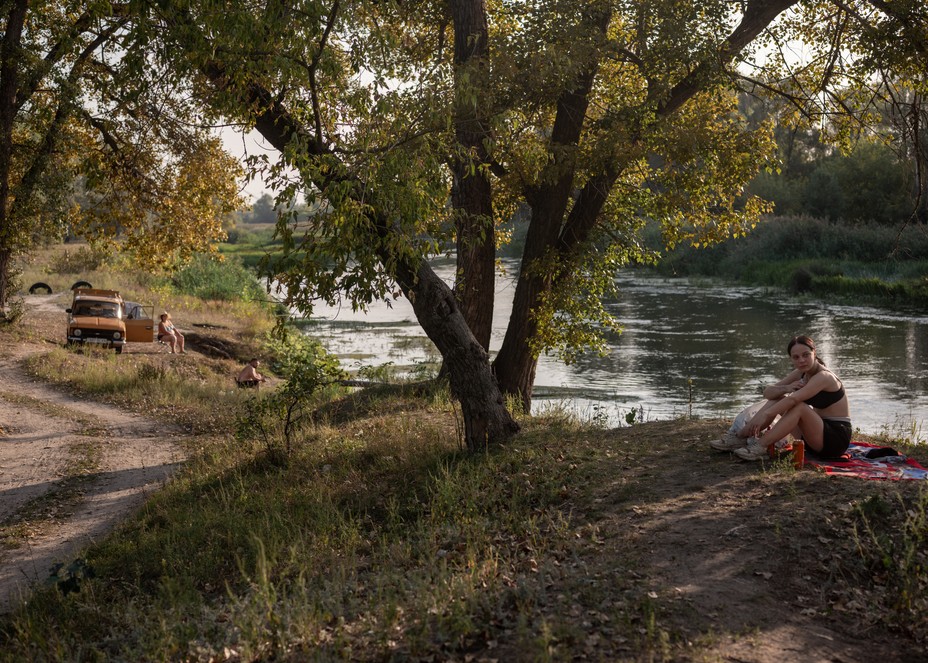
Jedrzej Nowicki for The Atlantic
Diana, a 17-year-old, sits on the financial institution of the Siverskyi Donets river in Izium, Kharkiv area of Ukraine.
Lots of of different kids have made the identical journey. I spoke with Olena Rozvadoska, the co-founder of Voices of Youngsters, a Kyiv-based nonprofit that gives psychological assist to kids, together with those that come from the occupied areas. “These youngsters are promised 1 million rubles in the event that they keep” within the Russian-controlled areas, Rozvadoska instructed me. “It’s nonsense. They are saying: ‘You should have nothing in Ukraine. It’s a pretend nation. You’ll be killed.’” The kids are usually euphoric after they first arrive in Ukrainian-controlled territory, she stated, however many succumb to despair afterward, particularly if they’ve left household within the east. That’s once they need assistance.
Behind the entire concern about the psychological well being of Ukrainian kids lurks a much bigger query concerning the generations too younger to have taken half within the unifying 2014 revolt towards Russia. The Revolution of Dignity introduced hundreds of younger Ukrainians into the middle of Kyiv and in the end deposed the Russian-backed President Viktor Yanukovych; the expertise was formative for Ukrainian Millennials, who solid their lot with a democratic West towards what many noticed as a rapacious and autocratic neighbor. It was additionally the instant precursor to the 2014 Russian annexation of Crimea and incursion into japanese Ukraine.
Right this moment’s younger folks have lived beneath martial legislation for 3 and a half years, with no close to prospect of collaborating in significant elections; their political and social isolation has left many Ukrainians questioning whether or not they are going to inherit their elders’ dedication to democracy. However Anton Grushetskyi, a Kyiv-based pollster, instructed me that he noticed some encouraging indicators—as an example, that 60 p.c of younger Ukrainians consider {that a} profitable life is feasible of their nation, regardless of what appears to most of them like a everlasting state of conflict.
Many on this younger cohort might share the idealism that drew their predecessors to the barricades, even when they haven’t had a lot likelihood to point out it. I met a number of adolescents who stated they took critically the concept their era may assist present an ethical instance to the world. One was a 19-year-old college scholar from Kharkiv named Anna Kovalenko, who not too long ago organized a collection of musical and inventive gatherings referred to as Creativeness House that drew lots of of individuals. She grew up in Saltivka, an enclave in northern Kharkiv that was hit very onerous throughout the first month of the 2022 Russian invasion. Her mom had needed to get her out of Ukraine on the time—the household had gives of assist and cash from overseas—however Kovalenko instructed me that she’d refused to go away her father and grandparents. She hopes to change into an architect and assist rebuild her nation after the conflict ends.
“Each time folks could possibly be helped, I’m overexcited; I barely explode,” she stated over the din of an air-raid siren in a Kharkiv cafe. “It’s wonderful that I may be useful on this place. That’s why I’m nonetheless right here.”
In July, hundreds of younger folks participated in anti-corruption protests throughout the nation. The rallies succeeded in stopping the passage of a invoice that may have decreased the independence of two of Ukraine’s anti-corruption our bodies. Yana Sliemzina, a 29-year-old journalist who helped arrange one of many road protests in Kharkiv, instructed me that the victory was a political ceremony of passage for her and plenty of others, partly as a result of corruption has been one thing of a taboo topic in recent times, due to its distinguished position in Russian propaganda towards Ukraine. Others who took half instructed me they have been joyful for any likelihood to claim their perception in democracy after years of feeling that their lives have been completely on maintain, their horizons shrunken by a continuing, anxious seek for social-media tips on the place the following drone would strike.
In a conflict that has come to look limitless, many younger folks instructed me that they like not to consider the longer term in any respect. Maybe that’s as a result of they know the conflict’s finish will convey an entire new set of challenges and a distinct sort of heroism. They should restore a shattered, traumatized nation filled with single moms, maimed veterans, and homeless and displaced folks. The surface world could also be a lot much less keen to assist them than it’s in the present day.
“It’s very onerous, the load of all of it,” Katya Markevych, a 15-year-old in Kharkiv, instructed me once I requested her to check life after the conflict. “We really feel like we should rebuild this nation actually and metaphorically. It’s a whole lot of duty.”