Health & Wellness
The Island With out Time – The Atlantic

Dec
When the solar rises on Could 18 within the small Norwegian fishing village of Sommarøy, positioned above the Arctic Circle, it doesn’t set once more till July 26. Later within the 12 months, it vanishes from November till January.
Within the winter, the island is roofed in snow. However throughout the midnight solar, the climate is temperate, even sizzling. Purple wildflowers stick out of mossy grass, and the electric-blue water and white sand look extra Caribbean than Arctic. Strolling alongside the coast round 11 p.m., you may see kayakers paddling on the sleek sea within the distance, or kids in pajamas fishing and operating alongside the seashore with their catches.
Impressed by the intense durations of sunshine and darkish, in late spring 2019, a gaggle of locals signed a petition to make the village the primary “time-free zone,” a spot the place anybody may purchase groceries, lower grass, or eat dinner irrespective of the time. Their reasoning made sense sufficient: In a city the place the solar shines at 1 a.m. in July and you may see the celebs at 1 p.m. in December, the time on the clock is meaningless. Worldwide media seized on the time-free zone as a curiosity, and the city leaned into the branding, flaunting its freedom from the clock and alluring others to expertise it. The realities of tips on how to run a enterprise, coordinate work, and have a social life with out time went unmentioned; what mattered was the fantasy of a time- and stress-free life.
Some semblance of time does exist on Sommarøy. The grocery retailer, which is the one true retailer on the town, has opening and shutting hours, as does the café on the seashore. The lodge has common check-in and check-out instances. Folks have cellphones that inform time.
But after I visited in July, the island was deep into its nightless rhythm, and I noticed indicators that the clock held little sway. After I tried to schedule a gathering with Olivier Pitras—the 65-year-old proprietor of a bed-and-breakfast and a kayak-rental firm that offers midnight excursions—he informed me to easily drop by his store and see if he was out there. To realize even additional immersion within the time-free life, I obscured the clocks on my telephone and my laptop computer and blocked the time of incoming e mail. The night time I arrived, I walked across the whole island at a simple tempo. The colours within the sky resembled daylight I used to be aware of seeing at 7 or 8 o’clock within the morning. However was it really 8 p.m.? Midnight?
For 9 days, I tried to dwell outdoors of time in a white picket home with a wraparound porch. On some other journey, I might in all probability sit outdoors within the evenings and watch the solar set. As an alternative, the solar moved in a circle over my head, prefer it was caught within the loop of a spinning lasso.
Ingun Mæhlum for The Atlantic
A working clock within the café hooked up to Sommarøy’s grocery retailer
The need to eliminate the clock completely cuts in opposition to a really human impulse to manage, predict, and measure time. The Babylonians used the moon to mark out a 19-year cycle during which seven years contained 13 months and the others, 12. Historical Egyptians as soon as stored monitor of time by the rise and fall of the Nile River. Indigenous teams in Siberia have a free lunar calendar organized by months with names reminiscent of “ducks-and-geese-go-away month.” Within the Trobriand Islands, the brand new 12 months historically begins when marine worms swarm on the floor of the water to breed. Close to Sommarøy, the Indigenous individuals who dwell in northern Norway, the Sámi, have eight seasons that observe reindeer migration.
However the extra a society trades and travels, the extra it should adapt its time system to be constant and coordinated. Hours of uniform size had been extensively adopted solely within the 14th century, when clocks may preserve equal durations. (Beforehand, dividing durations of daylight into 12 hours, because the Romans did, meant the size of these hours would differ seasonally.) “There are few higher revolutions in human expertise than this motion from the seasonal or ‘non permanent’ hour to the equal hour,” the historian Daniel J. Boorstin wrote in his ebook The Discoverers. “Right here was man’s declaration of independence from the solar, new proof of his mastery over himself and his environment.” In 1967, the clock’s divorce from the pure world was finalized: The Worldwide Bureau of Weights and Measures adopted a definition of a second measured by the oscillations of a cesium atom, slightly than a fraction of the photo voltaic day.

By Daniel J. Boorstin
Sommarøy’s time-free zone was, in a way, an try by residents to reclaim their connection to a extra pure measure of time. In spite of everything, yearly, the island experiences roughly 1,656 hours of consecutive daylight. It’s nearly as if people moved to Mercury, the place the day—midday to midday—lasts 176 Earth days, however by no means adjusted their watches.
The concept of tossing clock outing the window clearly had vast enchantment: Practically 1,500 information retailers world wide coated the 2019 petition that proposed the time-free zone. Kjell Ove Hveding, a Sommarøy native, went to Oslo to hand-deliver it to the Norwegian politician Kent Gudmundsen. “There’s no must know what time it’s,” Hveding mentioned in a press launch that included an image of him destroying the face of a clock. Native press printed a photograph of watches—reportedly deserted by clock-weary residents—held on a bridge resulting in the island.
However quickly after the time-free zone went viral, the story started to crack. An worker at Sommarøy’s solely lodge expressed skepticism to the Norwegian public-broadcasting firm, NRK, {that a} functioning enterprise may function with out its clocks. Hveding turned out to be part-owner of mentioned lodge, with one thing to realize from rising tourism to the island. An NRK investigation revealed that the petition was funded by a state-owned firm, Innovation Norway, that promotes Norwegian companies. The corporate paid for extra assist from PR businesses in Oslo and London. NRK additionally reported that the watches on the bridge weren’t a results of swelling help from locals, however belonged to Hveding and some others. They had been eliminated after the photographs had been taken. Gudmundsen informed NRK that after his photograph op, the bundle of papers with signatures was additionally taken away and by no means submitted to the federal government. Innovation Norway issued a public apology.
To today, Hveding denies that the marketing campaign was a ruse. “That is us, that is how we dwell,” he insisted to The New York Occasions in 2019. Later that 12 months, Sommarøy residents took over a Fb web page devoted to the time-free zone (and now not affiliated with Innovation Norway), inviting individuals from “down south on the planet the place nights are darkish” to see for themselves what dwelling time-free may very well be like.
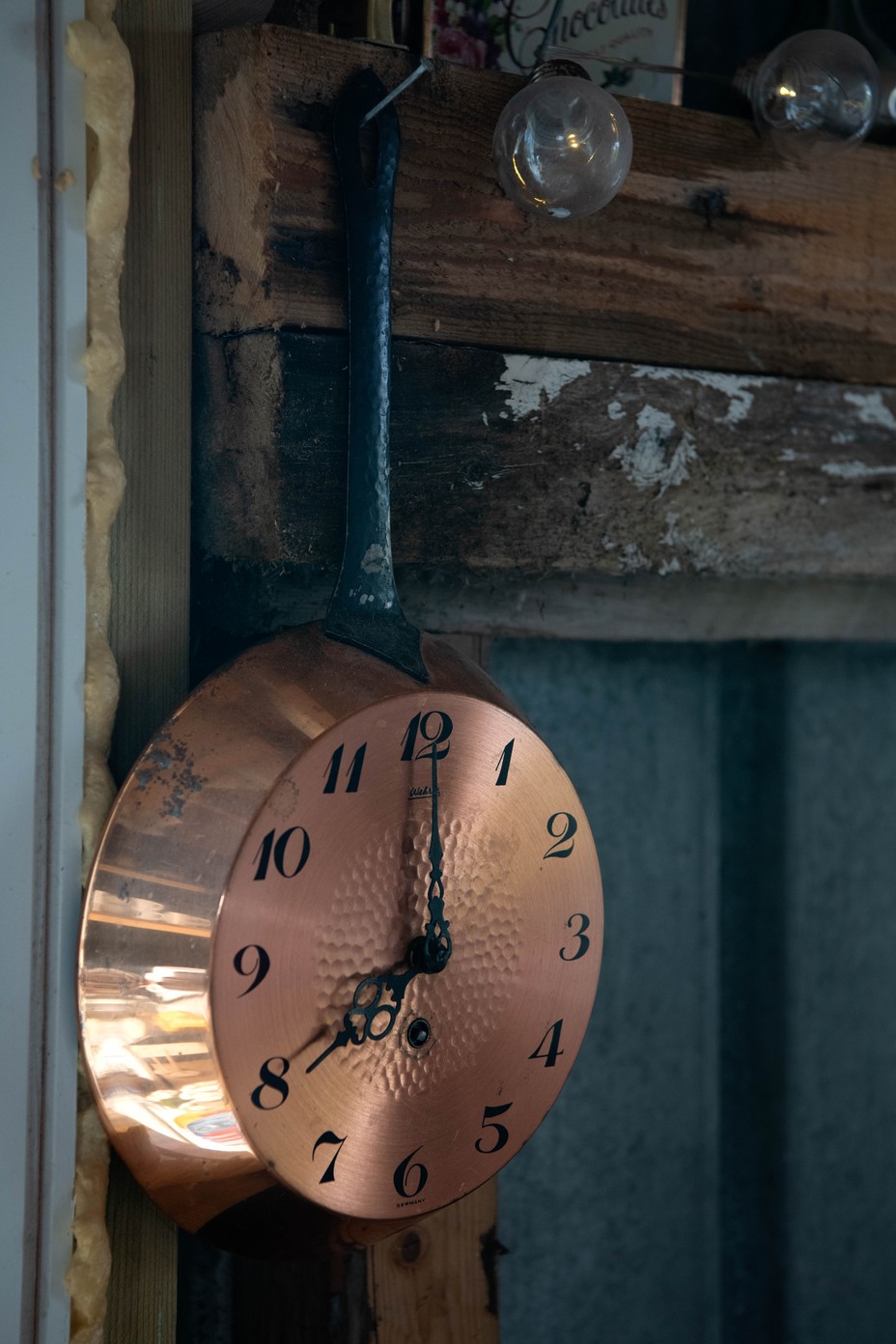
Ingun Mæhlum for The Atlantic
A damaged clock in Sommarøy

Ingun Mæhlum for The Atlantic
Cod hanging out to dry
Pitras and I by no means set a exact second to fulfill however simply discovered time on one of many situations I walked previous his kayak-rental enterprise. On a cloudless day, we sat at a picket desk behind the store, dealing with the water. Pitras placed on his sun shades, whereas I shielded my eyes and described a idea about time I’d been mulling over.
Since 2011, the researchers Tamar Avnet, at Yeshiva College, and Anne-Laure Sellier, at HEC Paris, have studied individuals’s preferences for dwelling with time. Clock-timers, as Avnet and Sellier have dubbed them, do issues primarily based on what their watches say. However for event-timers, the precise minute or hour doesn’t matter. A clock-timer may get up every day at 7 a.m., begin working at 9 a.m., eat lunch at midday when it’s delivered, and get into mattress at 10 p.m. An event-timer rejects the alarm clock, perhaps waking up at 6 o’clock, perhaps at 9. They’ll cease working once they really feel a activity is finished, or eat once they get hungry, however at no predetermined time.
Sommarøy did appear to have every day rhythms, I informed Pitras. I may determine the evenings by the best way the city went quiet, most homes’ blackout curtains drawn and their inhabitants sleeping inside. However I questioned aloud whether or not individuals in Sommarøy had been particularly adept at transferring out and in of clock time. Pitras definitely was. He has been a sailor for 46 years, he informed me. When crusing on a ship alone, he carried out duties once they wanted to be performed, day or night time; when crusing on a crew, he adopted strict schedules. Now, when he organizes Arctic expeditions throughout the midnight solar, the teams enter a shared occasion time. They go mountain climbing as they collectively please, even when at midnight; come again for dinner at 5 a.m.; fall asleep; then get up for breakfast at 2 p.m. Pitras mentioned shifting between clock and occasion time is less complicated for him with out the solar’s clear demarcation between day and night time.
Others I spoke with in Sommarøy additionally described a way of freedom and company. Halvar Ludvigsen, a fourth-generation resident of Sommarøy, invited me onto his porch after I approached him. “I work at night time, and I don’t care in regards to the time,” Ludvigsen mentioned, in a gruff voice. Neither did his retired neighbor, who informed me that when he was rising up in Sommarøy, he labored all day on his household’s farm, then went fishing at midnight and invited the neighbors over for a meal. One more event-timer, I believed.
Ludvigsen informed me that he and Hveding, not the PR businesses, got here up with the concept of the time-free zone. Marianne Solbakken, a 67-year-old who grew up within the area, informed me one afternoon that all the drama over the publicity effort obscured the reality: Time is extra versatile in Sommarøy. “The life we dwell is actual,” she informed me. “How are you going to be inside when the solar is shining at 11 o’clock within the night?” Solbakken went to the unique assembly about establishing the time-free zone in June 2019, and even wrote a tune about placing her watch away throughout the summer season: “And if we need to paint the home in the course of the night time / Sure, then, we simply take out the paintbrush / Then we’ll name the neighbor and ask him to assist us / And it’s best to consider he’ll come quickly.” (The lyrics, which sound higher in Norwegian, are set to the melody of a well known tune by Halvdan Sivertsen.)
As my week went on, I participated in a form of event-time Olympics. I labored after I needed to, ate after I was hungry, and went mountain climbing at night time—till 11 p.m., the file confirmed later. (My fiancé, who traveled with me, recorded after I ate, slept, wrote, learn, and exercised.) I felt an awesome expansiveness of option to be in whole management of my day, with out operating out of sunshine.
Time-management types do appear to affect how individuals expertise the world. In Avnet and Sellier’s research, at the least, clock-timers had been extra more likely to consider that occasions are steered by destiny, not by intention. They’re additionally worse at distinguishing between occasions which might be causally linked and occasions which might be unrelated. Those that observe occasion time usually tend to say that what occurs every day is a results of their very own actions. In one in every of their experiments, Avnet and Sellier break up contributors into two sorts of hot-yoga lessons: one during which instructors suggested individuals in a clock-free room to maneuver by means of poses with out consideration to how lengthy every was held, and one during which a trainer famous how a lot time must be spent in every pose. Within the clock-time class, college students skipped and gave up on extra poses than within the event-time class—and had been extra more likely to contemplate the trainer answerable for these failures. College students had much less constructive experiences within the clock-time class.
Regardless of such findings, Avnet and Sellier pressured to me that they don’t regard clock or occasion time as superior, and in fact, all of us have interaction with each time types. However it’s clock time that’s imposed on most of us from a younger age, Kevin Beginning, an anthropologist at CUNY Queens Faculty, informed me. Outdoors of trip, most individuals don’t get the possibility to embrace occasion time—even when it would go well with them. In his 2015 ebook, the sociologist Hartmut Rosa wrote that fashionable people crave detachment from social acceleration, which he outlined because the rising “expertise per unit of time.” Maybe that’s why so many individuals had been charmed by the concept of a time-free zone. On the southern finish of the island, I usually stopped on the seashore café, the place Gjertrud Tvenning Gilberg sells charcuterie, together with do-it-yourself truffles, pastries, and soup. “Most individuals who come right here dwell in cities, and there’s a giant rush,” Tvenning Gilberg mentioned. Maybe Sommarøy isn’t strictly with out time, however it presents a short lived respite for individuals who use the clock to harness their busyness.
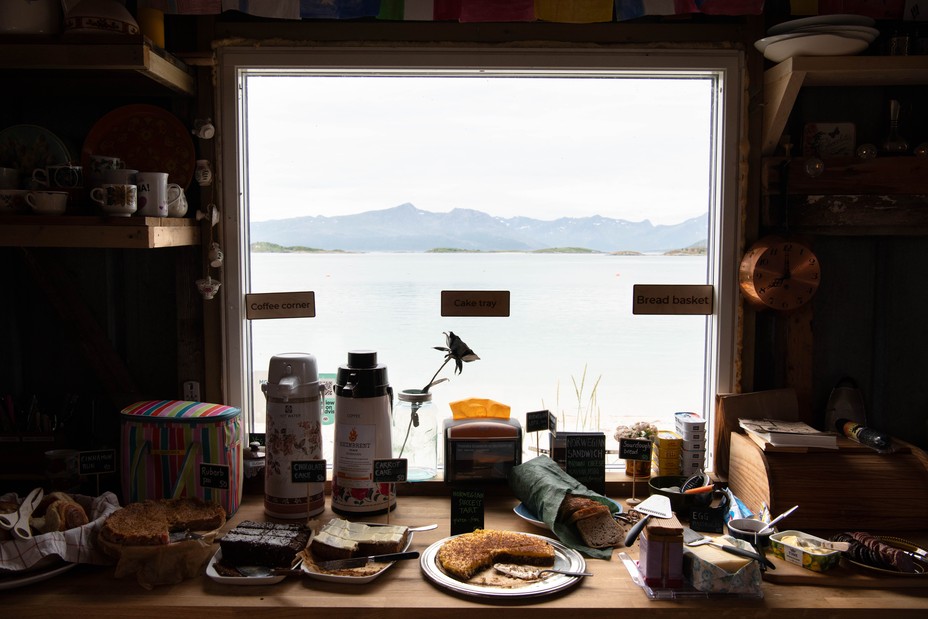
Ingun Mæhlum for The Atlantic
Gjertrud Tvenning Gilberg’s beach-café choices
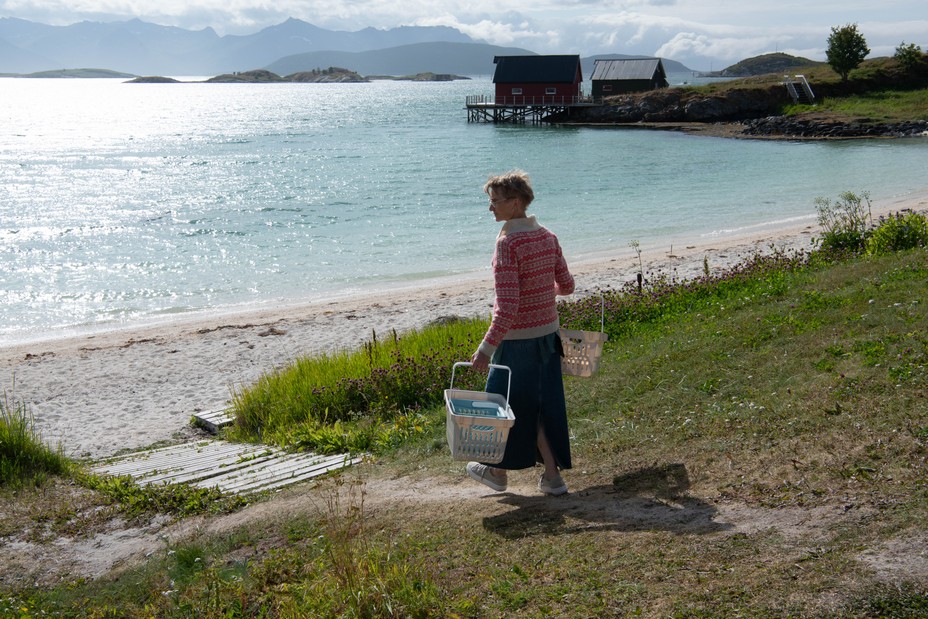
Ingun Mæhlum for The Atlantic
Gjertrud Tvenning Gilberg runs a seashore café in Sommarøy. She carries the whole lot from her home to the café.
As an event-timer doing my greatest to dwell in a clock-time world, I anticipated to thrive in my non permanent timelessness. However after just some days in Sommarøy, the clock started to hang-out me. I started to doubt whether or not I used to be doing issues on the “proper” time. I missed the sensation of progressing towards a end line, and developed sturdy urges to examine the time when nobody was watching. I hated counting on my fiancé to inform me that it was time for a piece name. In the end, I slipped right into a routine; later, I realized that it intently resembled my schedule at residence.
After we talked upon my return, Avnet guessed that I had been uncomfortable with the 24-hour solar. She mentioned that, paradoxically, pure clock-timers might flourish extra in Sommarøy. “A clock like me, I get up at 7 a.m. regardless if the solar comes up at 5 or if it comes out at 9,” she mentioned. However dedicated event-timers may wrestle with out non-clock cues to drive our actions.
There haven’t been research on time preferences above the Arctic Circle, or how individuals there view destiny and handle their feelings in relation to how they view time. (Avnet and Sellier informed me they hope to do analysis in northern Norway sooner or later.) However individuals in northern Norway don’t appear to have increased charges of psychological misery throughout the winter than they do in different seasons, as you may anticipate of people that spend so many weeks in the dead of night. Kari Leibowitz, a psychologist who has studied Norwegians on this area, wrote for The Atlantic in 2015 that those that lived farther north had a extra constructive, and protecting, mindset in regards to the wintertime. One other approach to have a look at it’s that they’re extra accountable for their actions, whatever the mild ranges outdoors. In Cincinnati in January, you won’t go for a run at 10 p.m., as a result of it’s darkish. But when it’s darkish at 3 p.m. or 10 p.m. in Sommarøy, the shortage of sunshine received’t cease you.

Ingun Mæhlum for The Atlantic
Sommarøy
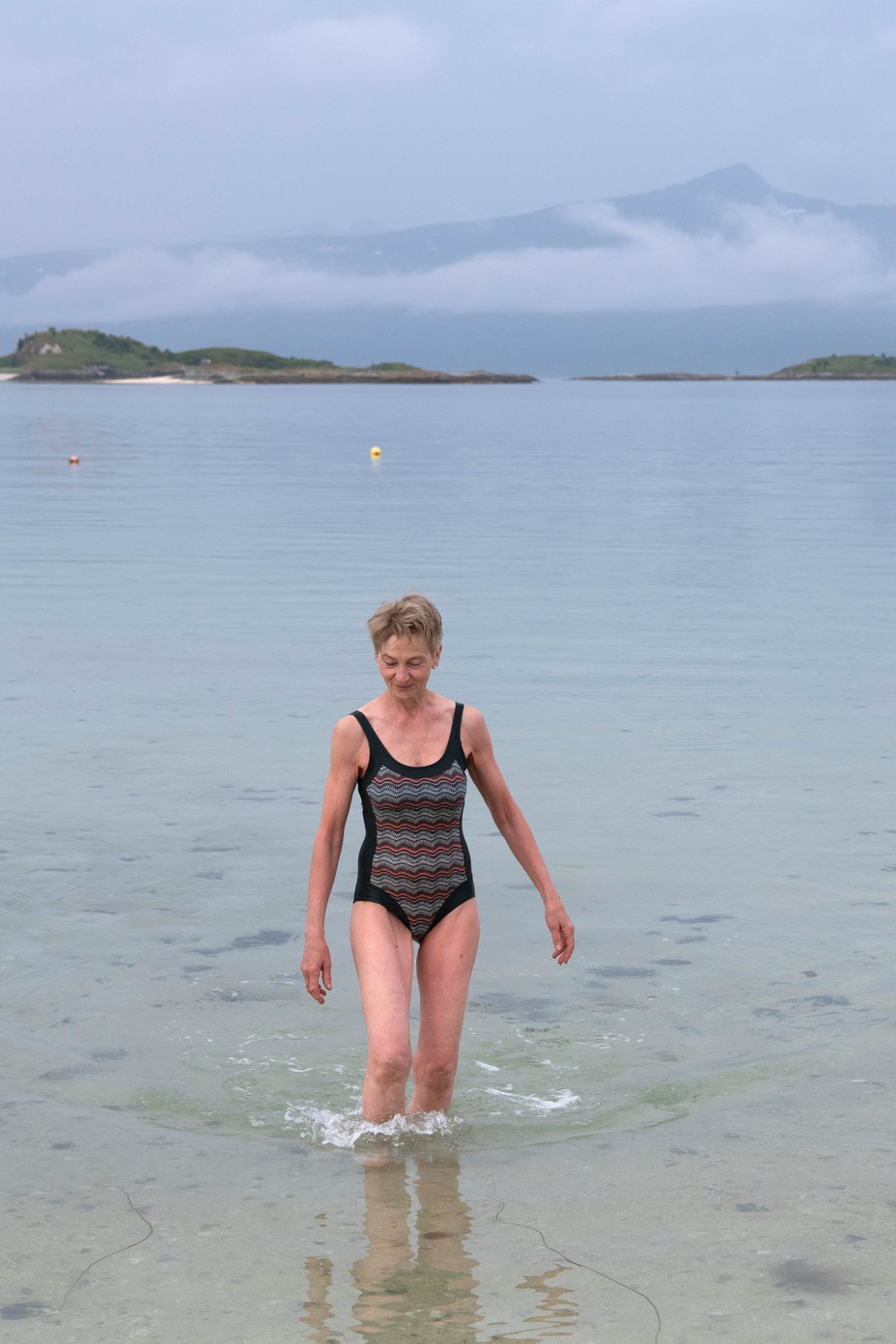
Ingun Mæhlum for The Atlantic
Gjertrud Tvenning Gilberg swims within the ocean each morning.
I noticed Tvenning Gilberg, the café proprietor, as a job mannequin of routine inside timelessness. Day-after-day, winter or summer season, she will get up early, reads, writes, and swims within the ocean proper outdoors her door, however not primarily based on the time on the clock. (She informed me she makes use of her clock nearly completely for baking.) She has hours on the café, however ones she units herself. She had a profession as a meteorologist, she informed me, so she extra intimately understands the solar’s actions, even when it doesn’t rise or set. Within the winter, although the solar doesn’t rise, she acknowledges a brightening of the sky throughout the day. In the summertime, the solar will likely be to the south by noon, and at midnight, to the northwest.
That’s the place I ought to search for the primary official sundown of the summer season, Tvenning Gilberg informed me. It will happen on my final night time, at 12:30 a.m.; the solar would rise once more simply 49 minutes later. I un-hid the time on my telephone so I may catch the precise second—however that night time was cloudy. Someplace beneath the grey mist, I knew the solar had fallen under the horizon. I wanted I may have seen it. The day I landed in New York, I made some extent of strolling to the East River at nightfall. I wasn’t fairly positive of the time, however I felt immense reduction wanting on the darkening sky.

By Hartmut Rosa
Whenever you purchase a ebook utilizing a hyperlink on this web page, we obtain a fee. Thanks for supporting The Atlantic.