Health & Wellness
Historic Roman bottles contained traces of fecal matter : NPR
Feb
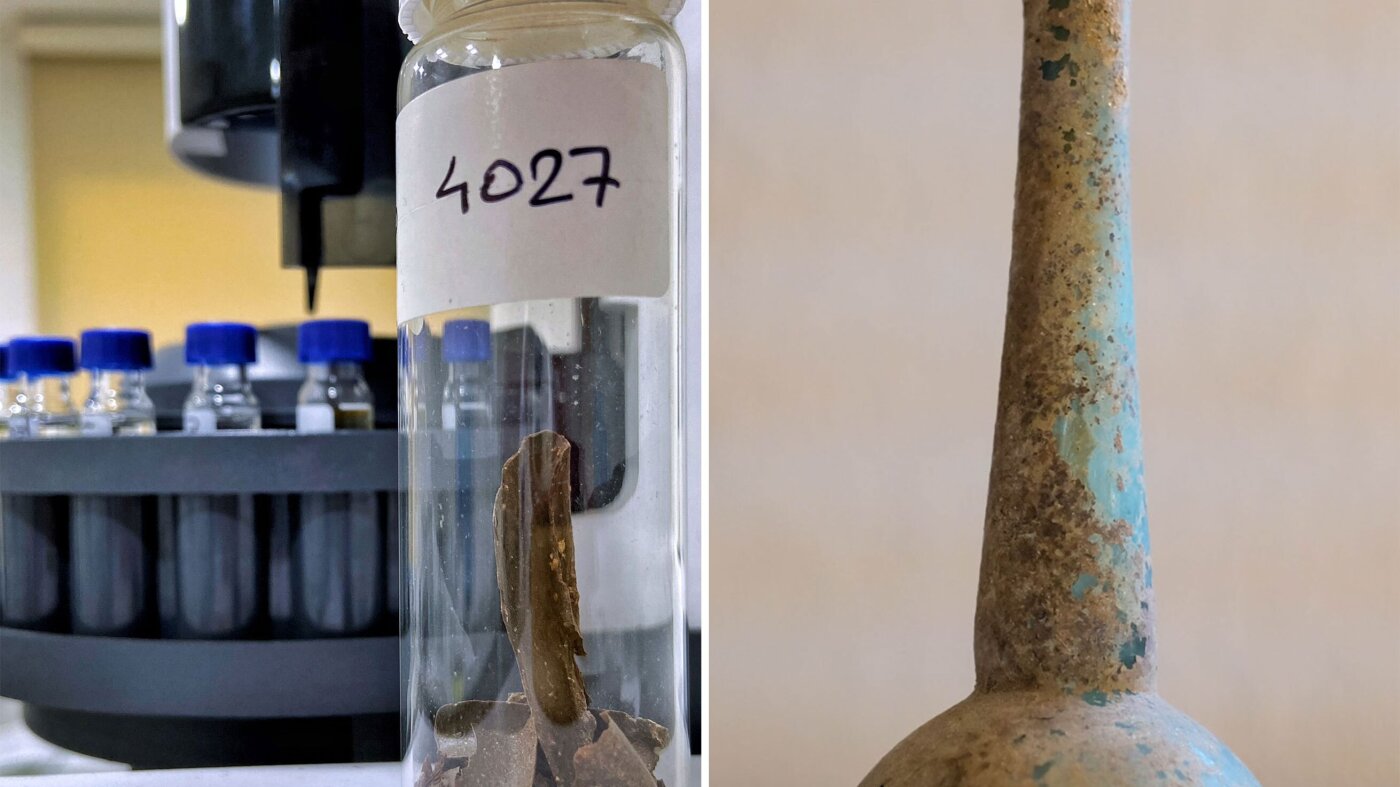
Researchers scraped residue from historic Roman bottles and found what might need been a medical concoction.
Ilker Demirbolat (left); Atila Cenker (proper)
disguise caption
toggle caption
Ilker Demirbolat (left); Atila Cenker (proper)
A number of the earliest writings — together with these inscribed on papyrus in Egypt and later in historic Greece and Rome — comprise recipes for making medicines.
Discovering bodily proof, nonetheless, that confirms such recipes had been ready and used to deal with precise illnesses in antiquity is uncommon.
Now, in analysis revealed within the Journal of Archaeological Science: Reviews, researchers describe chemical proof of a medicinal recipe penned greater than 2 millennia in the past by Galen, the well-known Greek doctor of historic Rome. It includes a mix of human feces and perfume. Such an arresting mixture mirrored Galen’s directions for masking the odors of sure foul-smelling medicines.
“It was a exceptional second of interdisciplinary work,” says Rana Çelebi, a medical historian at Istanbul Medipol College who contributed to the analysis, “to supply a uniquely tangible window into the traditional medical observe.”
Medicinal poop is not only a factor of the previous. Some trendy physicians have began utilizing it as a sort of intestine microbiome reset for these battling a debilitating sort of GI an infection attributable to the bacterium Clostridium difficile, and are researching it for different makes use of. Somewhat than mixing it with aromatics to make it extra palatable, at this time the excrement is sealed inside a capsule or transplanted into the massive gut.

Atila Cenker, an archaeologist at Sivas Cumhuriyet College; Rana Çelebi, a medical historian at Istanbul Medipol College; and chemist Ilker Demirbolat of Istanbul Kent College.
Ilker Demirbolat
disguise caption
toggle caption
Ilker Demirbolat
A good looking assortment of little glass bottles
The just lately revealed challenge started a number of years in the past when Atila Cenker, an archaeologist at Sivas Cumhuriyet College, approached Çelebi and informed her that he had entry to a group of historic Roman vessels referred to as unguentaria, lengthy regarded as fragrance bottles.
Çelebi leapt on the probability to work with “these exceptionally well-preserved historic glass vessels,” she says. She hoped to seek out traces of an historic fragrance within the long-necked bottles, equivalent to people who “may very well be used within the temple for ceremony.”
“We thought, what if these residues may nonetheless converse?” she says.
The bottles had been practically 2,000 years previous and housed on the Bergama Archaeology Museum in western Turkey. That is the town the place Galen grew up and studied medication in some of the well-known therapeutic temples of the time.
So Çelebi and the archaeologist teamed up with a chemist, Ilker Demirbolat of Istanbul Kent College. And the three of them traveled to the museum in Bergama for a really particular mission.
A police officer escorted them to the huge door of the archive. “We had been opening these drawers, choosing up vessels, them,” she says. It was for analysis but in addition, she says, “for the curiosity, as a result of they had been stunning. And also you had been touching these thousands-of-years-old vessels.”
The trio chosen 9 of them and scraped out their residues. “We had been very nervous,” says Çelebi. “They’re so delicate. What if we break them? Then what?”
Thankfully, no historic glassware was harmed within the taking of the samples.
An excremental eureka
Again in Istanbul, Demirbolat ran the chemical analyses in his lab “to see whether or not they may match any of the well-known fragrance or therapeutic recipes from antiquity,” says Çelebi.
Many of the bottles did not comprise something that fascinating. However certainly one of them “ended up revealing one thing much more shocking and medically vital,” she says.
It turned out to be human feces.
“The usage of fecal matter was throughout historic medical literature,” Çelebi says. “Everybody wrote about it, even the Egyptians — excrement of donkeys, canine, gazelles and even flies had been used,” although not often that of individuals. “Once we take a look at China, additionally they used feces.”
Such scatological remedies had been thought-about a potent therapy for a broad vary of infections and irritation, although “we do not know how profitable they had been,” admits Çelebi.
The researchers additionally discovered hint quantities of fragrant compounds in that cup bottle, probably from thyme or oregano — maybe used to masks the odor of the poo.
Not fairly 2,000 years in the past, Galen wrote down this very recipe. Now it does not simply exist as phrases. “Yeah, I imply, it is actual,” says Çelebi. “We discovered it. It wasn’t a fragrance — it was one thing completely reverse.”
“That is the primary scientific proof which sustains what’s written in historic books,” says Maria Perla Colombini, a professor emeritus of analytical chemistry on the College of Pisa who wasn’t concerned within the analysis. “It is fairly troublesome to seek out these molecules.”
Colombini is impressed by the rigor of the evaluation, however she will be able to’t be certain whether or not the contents of this explicit vessel had been used for medication. Maybe, she says, they had been used cosmetically. “This residue incorporates numerous info, however we’re not capable of know every thing,” she says.
As for Çelebi, she says early on, earlier than she and her colleagues knew precisely what was in that bottle, they’d the thought of internet hosting an occasion to current their analysis and re-create the traditional recipe for individuals to scent and even style.
“That was our dream for this analysis, however as a result of now we now have fecal matter and oregano, we’re not in a position to do that occasion,” she says with amusing.
“I hope subsequent time we discover an historic components that was an actual fragrance and used as a drugs with a pleasant aromatic scent.”
That’s, a top-smelling fragrance — as a substitute of possibility No. 2.