Health & Wellness
Wildlife commerce ups the chance of ailments spilling over to … us : NPR
Apr
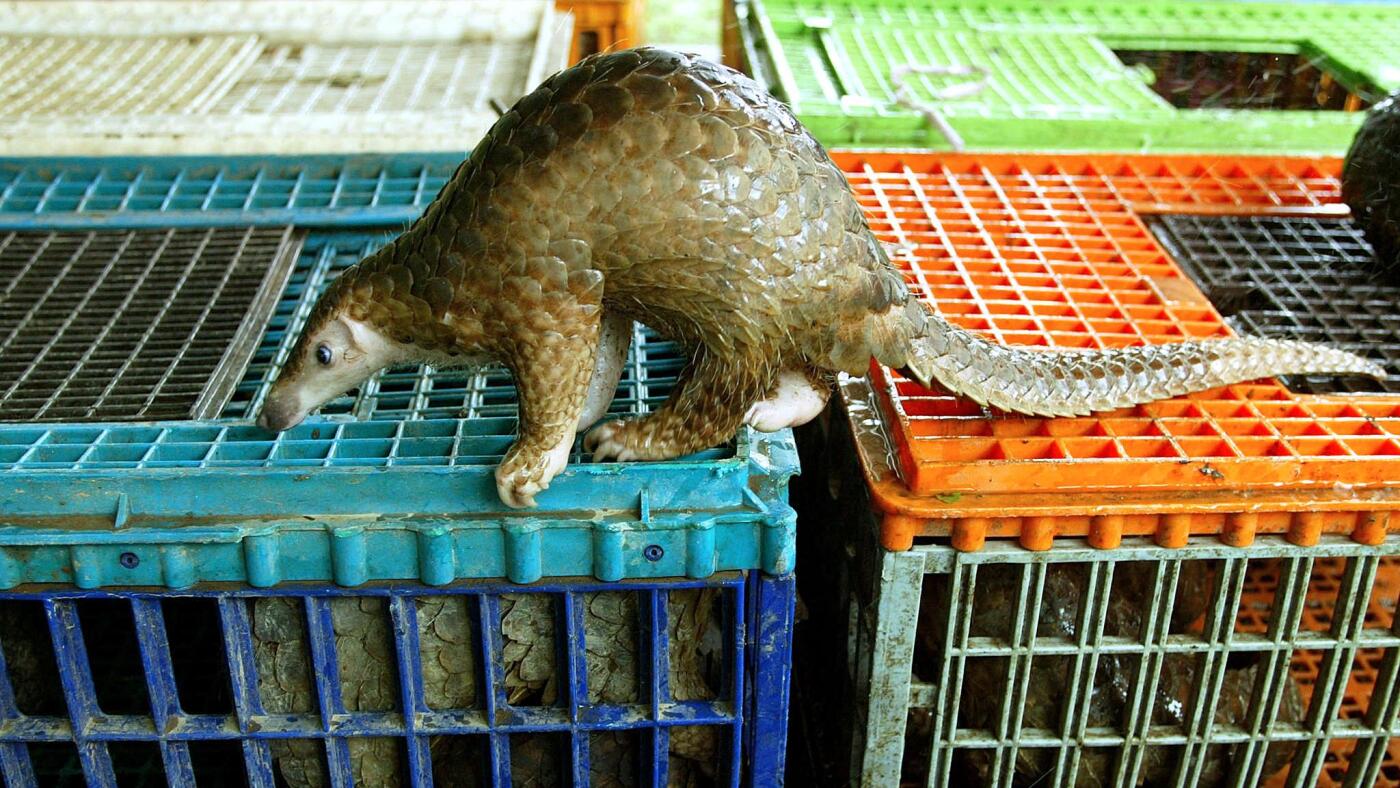
This pangolin was confiscated from a smuggling ring that offered endangered animals to eating places in China. Animals caught up within the wildlife commerce pose an ideal danger of spillover ailments.
Jimin Lai/AFP/through Getty Photos
disguise caption
toggle caption
Jimin Lai/AFP/through Getty Photos
In 2003, a cargo of unique African rodents to a pet retailer in Illinois sparked america’ first mpox outbreak. Gambian big rats and different rodents contaminated prairie canine, which in flip contaminated practically 100 individuals who dealt with the animals.
Ebola outbreaks are sometimes triggered after contact with bats, that are typically eaten or used for conventional drugs.
And extra famously, a string of scientific papers recommend the COVID-19 pandemic originated on the Huanan Seafood Wholesale Market, the place scores of stay wild animals — racoon canine, civets, Himalayan marmots — have been housed in cramped quarters.
Anecdotes like these are examples of how the wildlife commerce — something from buying wild animals for meals to trapping them for pets — can open an avenue for pathogens to leap from animals to people. A single fateful encounter can result in lots of, 1000’s, even tens of millions of deaths.
“There’s been a consensus for a very long time that the wildlife commerce is a danger to human well being,” says Colin Carlson, a illness ecologist at Yale College. “However loads of what we all know is from anecdotes.”
That patchy view makes it onerous to know how dangerous the wildlife commerce is in comparison with different causes of the uptick of infectious ailments, says Carlson, like local weather change or deforestation. Whereas it is smart that traded species would infect people extra usually than non-traded species, scientists could not definitively reply the query with out extra knowledge.
Now, Carlson and his colleagues supply a solution. Traded mammals are about 1.5 instances as probably to be sources of human ailments than non-traded animals, the researchers report in Science. Crucially, the longer people have been interacting with a species, the extra viruses we’ve got in widespread — particularly when coping with unlawful animals and stay markets.
“It is a actually robust paper that reinforces what we have already form of identified,” says Kevin Olival, a illness ecologist on the College of Hawai’i who wasn’t concerned within the examine. “The wildlife commerce is certainly a danger for zoonotic ailments. It is pushed previous outbreaks, together with probably COVID-19, and if we need to stop the subsequent one, we want to consider this globally.
An atlas of pathogens
5 years in the past, a examine like this wasn’t actually doable, says Carlson.
“The information that we’ve got right here, on animals and their viruses [and other pathogens] did not exist,” he says, at the least not in a means that researchers may simply analyze. Carlson and his colleagues modified that.
They constructed databases to which they’ll add each newly found virus. By lining up this pathogen atlas with knowledge on the wildlife commerce — which mammals are traded and the way lengthy a species has been concerned — the crew may see which mammals share essentially the most pathogens with people.
The outcomes, whereas not a complete shock, have been placing. Out of greater than 2,000 traded species, 41% shared at the least one pathogen with people, in comparison with simply 6.4% of non-traded species.
Displaying that pathogens are shared does not say something about who did the sharing, nevertheless it’s probably that the overwhelming majority of those instances stem from pathogens leaping from animals to people, and never the opposite means round, says Carlson. “People are ubiquitous. We’re involved with every little thing, and we’re choosing up much more stuff than we’re placing down.”
Sure elements of the wildlife commerce researchers already see as dangerous appear particularly conducive to choosing up viruses, the researchers discovered.
“Stay animal markets are a serious danger issue,” says Carlson.
“We’re speaking about animals ill, crowded circumstances, bizarre combos of species,” he says. “We all know that viruses are evolving in actual time in these markets as they transfer between species.” The individuals who work in these markets usually do not have the form of protecting gear that might cease pathogens.
The unlawful wildlife commerce, which incorporates endangered or protected animals like pangolins and squirrel monkeys, was additionally related to an elevated danger of spillover. That may very well be as a result of such species home extra viruses or unlawful markets may very well be much more lax in hygiene, says Carlson.
Lastly, the crew discovered that point issues. For each ten years a species spends within the wildlife commerce, one other new pathogen is leaping over into people, the examine discovered. “That is vital,” says Olival, and is smart, although he wonders whether or not that pattern may very well be pushed by improved pathogen detection.
Altogether, there are lots of of species which have been traded for many years or hunted for millennia. “That is a one-way ticket. In loads of methods, the toothpaste is out of the tube right here,” he says, and these animal viruses are with us to remain.
Threat discount
The outcomes additionally spotlight that taking motion now can scale back danger, says Sagan Friant, a illness ecologist at Penn State who wasn’t concerned within the examine. “This paper factors our consideration [toward] a means of blocking main routes that ailments are transmitted from animals to people. Should you can block these routes, then you are going to block loads of pathogens.”
Globally, that might imply governments cracking down on the unlawful wildlife commerce – beefing up surveillance at airports, as an illustration.
However Carlson notes that might finally push extra of the commerce underground, making it more durable to detect spillovers. “Now we have to decide on between criminalizing and pushing commerce underground, or discovering a technique to do public well being in [these] settings.”
Another choice is to handle demand for these unique species, which generates billions of {dollars} a yr.
“Although it looks like I am not concerned within the wildlife commerce, as a traditional citizen, you truly are,” says Olival. The 2003 mpox outbreaks within the Midwest “have been as a result of folks have been shopping for animals. In order that cute, little furry [exotic] animal in your pet retailer, possibly assume twice about it.”