Hair Care
Citizenship Verification Invoice Could Complicate Voting Registration for Hundreds of thousands of Ladies

Apr
Written By: Charron Monaye
As Congress debates the Safeguard American Voter Eligibility Act usually referred to in its up to date type because the SAVE America Act, a broader query is rising past election safety: who, in follow, will discover it tougher to vote? The Safeguard American Voter Eligibility Act, generally often called the SAVE Act, is one such piece of laws. Positioned as a measure to strengthen election integrity, it could additionally redefine who participates in American democracy, significantly ladies.
At its core, the SAVE Act would require voters to supply documentary proof of U.S. citizenship akin to a passport or start certificates, when registering or updating voter data. It might additionally restrict or remove broadly used programs like on-line and mail-in registration, shifting extra duty onto in-person verification. For thousands and thousands of People, this represents a procedural change. For a lot of ladies, it may turn out to be a structural barrier.
The place The Impression Turns into Actual
- Title Change Issues: A majority of ladies change their final title after marriage, creating mismatches between start certificates and present IDs—doubtlessly requiring extra authorized documentation to confirm identification.
- Decreased Registration Entry: Limitations on on-line and mail-in registration disproportionately have an effect on ladies who depend on versatile, distant choices because of work and caregiving calls for.
- Time Constraints: Ladies shoulder a bigger share of caregiving duties, making in-person necessities extra burdensome and fewer possible.
- Increased Administrative Burden: A number of steps to confirm identification can discourage or delay voter registration, particularly for these already balancing competing priorities.
- Financial Limitations: Prices related to acquiring passports, start certificates, or authorized paperwork can disproportionately affect lower-income ladies.
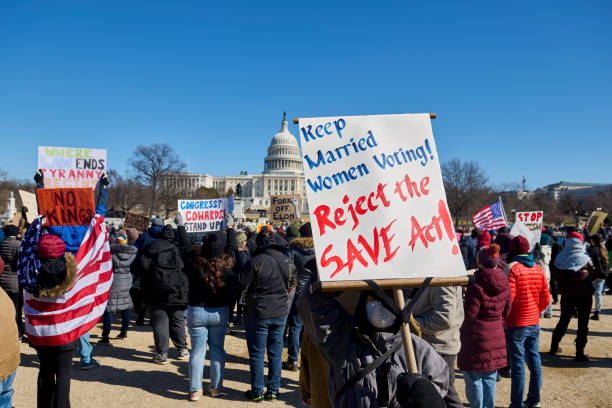
The affect begins with a uniquely gendered actuality: title adjustments. A major majority of ladies in america change their final title after marriage. Whereas culturally normalized, this follow creates a disconnect between start certificates and present authorized identification. Beneath stricter documentation guidelines, that hole turns into greater than administrative it turns into disqualifying. Ladies could also be required to provide extra authorized paperwork, navigate complicated verification processes, or face delays that in the end discourage participation.
Past documentation, the SAVE Act intersects with one other important dynamic time. Ladies proceed to hold a disproportionate share of caregiving duties, whether or not for kids, growing old dad and mom, or each. Insurance policies that require in-person registration, repeated paperwork, or prolonged follow-up successfully elevate the price of voting, not simply financially, however logistically. In an economic system the place time is already scarce, even minor will increase in administrative burden can have outsized results on participation.
There may be additionally a monetary dimension that can’t be ignored. Whereas proof-of-citizenship paperwork could sound commonplace, entry to them shouldn’t be common. Passports require charges and processing time. Beginning certificates could must be requested throughout state strains, usually at a price. For lower-income ladies who’re disproportionately represented amongst hourly staff and single-parent households these hurdles compound shortly. What seems to be a easy requirement turns into, in follow, a gatekeeping mechanism.
The Broader Enterprise & Coverage Implications
- Participation Shapes Coverage: Decrease voter participation amongst ladies may affect coverage outcomes on healthcare, schooling, and labor.
- Workforce Ripple Results: Insurance policies formed by a narrower voters could have an effect on office protections, pay fairness, and household go away buildings.
- Financial Illustration: Ladies drive a big share of shopper spending; decreased civic affect can not directly affect financial priorities and market conduct.
- Fairness And Entry Danger: Firms prioritizing DEI (Variety, Fairness, and Inclusion) could face a shifting exterior surroundings as civic entry adjustments.
From a market perspective, participation is all the things. In enterprise, boundaries to entry decide who competes and who’s disregarded. The identical precept applies to democracy. When entry turns into extra complicated, participation narrows. And when participation narrows, affect follows. Ladies, who make up a majority of the U.S. voters, have performed a decisive position in shaping outcomes on points starting from healthcare to financial coverage. Any shift that reduces their turnout has ripple results far past the poll field.
Supporters of the SAVE Act argue that requiring proof of citizenship is a needed step to safeguard elections. Critics counter that cases of noncitizen voting are exceedingly uncommon, making the coverage a broad resolution to a restricted downside. However the strategic query is much less about intent and extra about consequence. Even well-intentioned insurance policies can produce uneven outcomes once they intersect with present social and financial realities.
The underside line: laws that adjustments how individuals vote in the end adjustments who votes. And within the case of the SAVE Act, the ladies who’ve lengthy been a driving power in American civic life could discover themselves navigating new and surprising boundaries to being heard.